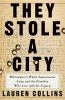
by Lauren Collins
Book list In 1898, white supremacists in Wilmington, North Carolina, seized control of the local government, unseated Black elected officials, ran the editor of the Black newspaper out of the city, and massacred Black residents. The new city leadership signed the White Declaration of Independence and celebrated their return to a pre–Civil War social order. For the next century, the same families governed the city and whitewashed its history. Journalist Collins presents an ambitious examination of the 1898 coup and its legacy. To understand the social, economic, and historical forces that led up to the events of 1898 and that persisted in the aftermath, Collins follows four families: the Howes and Halseys, both Black families, and the Bellamy/MacRaes and the Moores, both white families. Through deep research, Collins takes readers through more than two hundred years of Wilmington’s history. The white supremacist language, theory, and activity at that time bear chilling resemblance to the American political moment in 2026. Remarkably successful in its scope and depth, They Stole a City is an urgent argument for reckoning with history in order to understand the present backlash and rising white nationalism. From Booklist, Copyright © American Library Association. Used with permission. Library Journal On the night of November 9, 1898, an armed group of white supremacists initiated a riot in Wilmington, NC, which resulted in the deaths of as many as two hundred Black community leaders, ministers, lawyers, and citizens. Leaders of the local government were forced out of their positions, and members of the white supremacist group were installed in their places. For nearly a century afterward, the local media and officials downplayed the event, portraying it as a "necessary adjustment" in local government. Investigations into the incident were minimal. New Yorker writer Collins (When in French: Love in a Second Language), who is from Wilmington, presents 10 years of research on the event, including historical background, details of the night it happened, the years of cover-up, and a detailed, long-term analysis of its effects. Her book is told as a story through the lives of four local families across generations. Collins concludes that the effects of this murderous coup have never truly disappeared but continue to persist into the present. VERDICT This well-researched, highly readable work examining the devastating Wilmington coup d'état is shocking and critically important. Essential reading for all academic and public libraries.—Steve Dixon (c) Copyright Library Journals LLC, a wholly owned subsidiary of Media Source, Inc. No redistribution permitted. Kirkus New Yorker staff writer Collins delivers a scathing history of an infamous act of racial violence. The year 1898 saw a one-sided victory of U.S. military forces against Spain. In Wilmington, North Carolina, when troops returned that summer, led by a former Confederate and current Klansman, they were on hand to reinforce a white-supremacist movement that would erupt in horrific violence in the fall. Among the perpetrators were paramilitary vigilantes who, having gotten hold of a machine gun, murdered Black civilians, especially targeting community leaders among the city’s then-extensive Black middle class, and seized control of the city’s government, “completing what is thought to be the only successful coup d’état on American soil.” David Zucchino’sWilmington’s Lie (2020) helped resurface a story that many white North Carolinians have since tried to downplay or forget. Collins’ narrative takes that bloody historical event, with “dozens and perhaps hundreds of Black citizens” killed, and extends it to a larger legacy of racial oppression. The first Black officeholders of the time, she writes, served with “an awareness that almost anything they did could incite resentment and even violence from their white constituents”; those who followed faced challenges of their own. Meanwhile, the city’s white power elite committed themselves to exclusion and segregation well into the time of the Civil Rights Movement of the 1960s, which white North Carolinians resisted in outsize numbers, and on to the present. (“North Carolina is by far the most active state for the United Klans of America,” a Congressional committee held in 1965.) Collins concludes by recounting the difficult effort both to raise awareness of the 1898 massacre in curricula and public monuments as well as to secure some kind of belated justice, including possible reparations, in a time of a revanchist white-supremacist movement “spoiling to…bypass the democratic process with brute force.” An urgent work of reportage and historical research that lays bare structural racism past and present. Copyright © Kirkus Reviews, used with permission. Copyright © Kirkus Reviews, used with permission. |





